wargameitaliablog

wargameitaliablog
Blog italiani di gioco, pittura, storia... wargames

Visualizzazioni totali

Lettori fissi

martedì 10 aprile 2012

Le forze americane alla Battaglia di Bunker Hill - The American forces at the Battle of Bunker Hill


Illustrazione di Gerry Embleton - Illustration by Gerry Embleton

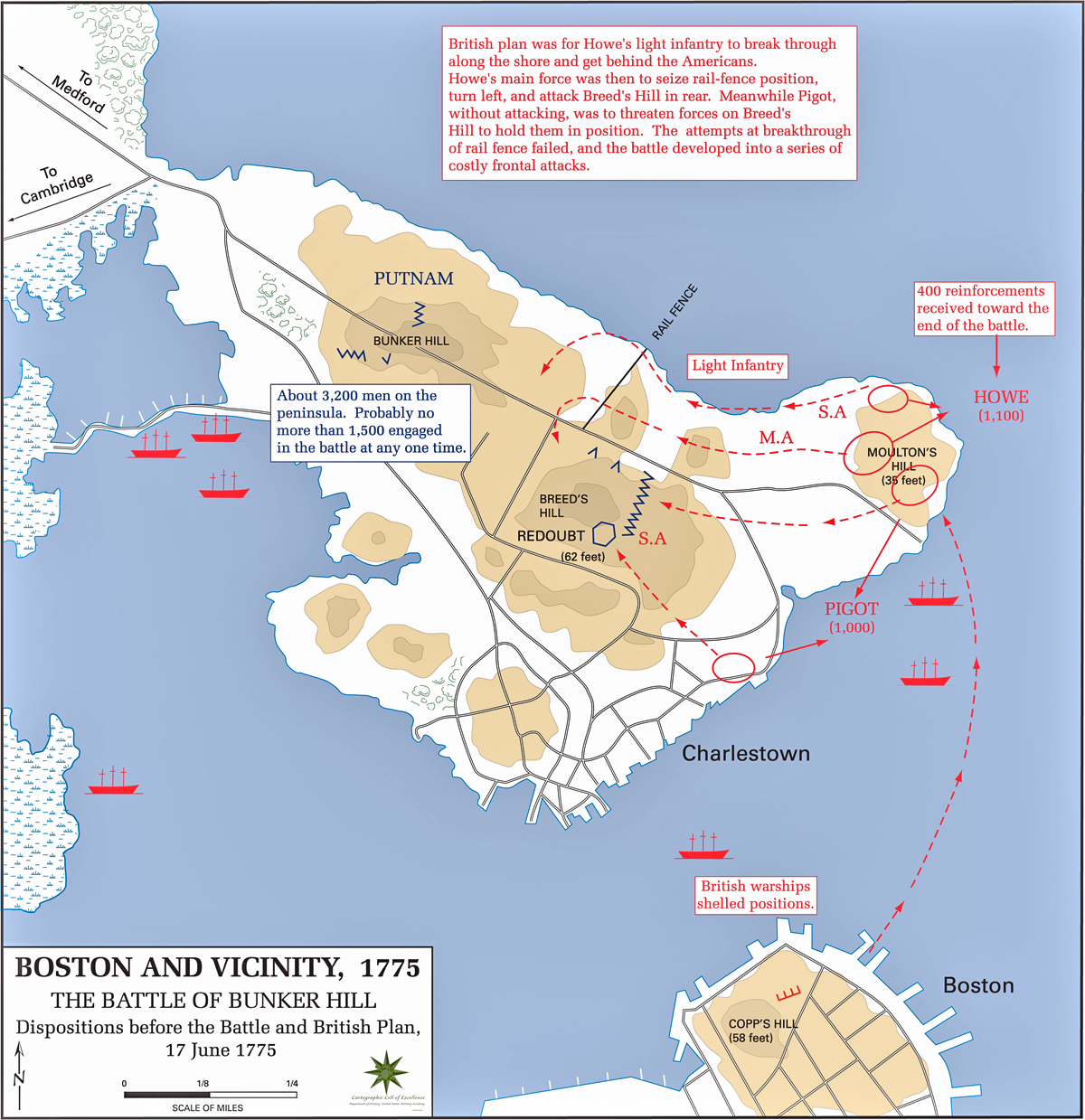
Posizioni americane sulla penisola di Charlestown - American positions on the peninsula of Charlestown

Movimenti delle forze britanniche - Movements of the British forces
Nei giorni successivi allo scontro di Lexington e Concord del 19 aprile 1775, una forza di 20.000 coloni americani si raduno nei dintorni di Boston.
Il generale Gage, preoccupato da questa massa di uomini, si rinchiuse nella città rinunciando a difendere le zone circostanti.
Il Congresso Provinciale del Massachusetts formò un esercito d’osservazione agli ordini del generale Jhon Thomas, lentamente andava prendendo forma l’assedio americano alla città.
Successivamente il Congesso Continentale, riunito a Filadelfia, costituì un Corpo d’osservazione.
Il 12 giugno Gage impose la legge marziale e decise l’occupazione di alcuni luoghi strategici nei dintorni di Boston, tra cui la penisola di Charlestown.
Scoperte le intenzioni britanniche la Commissione di sicurezza dei coloni americani, il 15 giugno decise di occupare la collina di Bunker Hill e di costruirvi delle opere di difesa.
Il 17 giugno 1775, quando sbarcarono sulla spiaggia della penisola di Cherlestown, i britannici dovettero affrontare circa 2.400 fanti americani con alcuni pezzi d’artiglieria, riparati dietro trincee e palizzate al comando del generale Israel Putnam, del colonnello Prescott e del dottor Warren.
Per lo svolgimento della battaglia e l’elenco delle forze britanniche rimando al post “Le unità britanniche alla battaglia di Bunker Hill / The British troops at the Battle of Bunker Hill” del 16 febbraio 2012.
La reale consistenza delle forze americane a difesa di Breed’s Hill non è certa, ma sembra che le truppe americane fossero le seguenti:

FORZE AMERICANE DEL CORPO DI OSSERVAZIONE
Comandante: maggior generale Israel Putnam (circa 2.400 fanti e alcuni pezzi d’artiglieria)

Brigata Prescott: colonnello William Prescott
            Rgt. Prescott (Massachusetts)
            Rgt. Freye (Massachusetts)
            Rgt. Bridge (Massachusetts)
            Rgt. Doolittle (Massachusetts)
Rgt. Brewer (Massachusetts)
Rgt. Nixon (Massachusetts)
Distaccamenti di schermagliatori a difesa della città di Charlestown
Batteria da 3 lb. di Gridley

Brigata Stark: colonnello John Stark
            Rgt. Stark (New Hampshire)
            Rgt. Reed (New Hampshire)
            Rgt. Knowlton (Connecticut) e Trevet (Mass.)

Le truppe americane erano totalmente formate da milizia, me non erano poi male, perché costituite anche da molti veterani delle guerre franco-indiane, inoltre molti miliziani erano abili cacciatori e quindi ottimi tiratori, soprattutto quelli armati di fucile rigato.
A discapito delle forze americane, invece c’era la mancanza quasi totale di baionette, che le rendeva vulnerabili nei combattimenti corpo a corpo e la mancanza di un comando unificato e di una linea di comando ben stabilita. Anche la mancanza di un valido rifornimento di munizioni ebbe un effetto negativo sull’esito finale del combattimento.
La brigata Stark - Stark Brigade

Gli abitanti di Boston seguono la battaglia dai tetti della città - The inhabitants of Boston follow the battle from the rooftops of the city

In the days after the battle of Lexington and Concord on April 19, 1775, a force of 20,000 American settlers are gathering in the Boston area.
General Gage, worried by this mass of men, shut himself up in the city refusing to defend the surrounding areas.
The Provincial Congress of Massachusetts formed an army of observation under General John Thomas, was slowly taking shape the American siege of the city.
Subsequently, the Continental Congesso meeting in Philadelphia, built a body of observation.
On June 12 Gage imposed martial law and decided the occupation of certain strategic locations in the Boston area, including the peninsula of Charlestown.
On 15 June, the Security Commission of the American colonists discovered the British intentions and decided to occupy the hill Bunker Hill building defense works.
On 17 June 1775, when they landed on the beach Cherlestown peninsula, the British were faced with about 2,400 American soldiers with a few pieces of artillery, trenches and take cover behind fences, under the command of General Israel Putnam, Colonel Prescott and Dr. Warren.
For the conduct of the battle and the list of British forces refer to the post "Le truppe britanniche alla battaglia di Bunker Hill / The British troops at the Battle of Bunker Hill" on 16 February 2012.
The real substance of American forces in defense of Breed's Hill is not certain, but it seems that American troops were the following:

AMERICAN FORCES OF THE CORPS OF OBSERVATION
Commander: Major General Israel Putnam (about 2,400 infantry and some artillery pieces)

Prescott Brigade: Colonel William Prescott
Rgt. Prescott (Massachusetts)
Rgt. Freye (Massachusetts)
Rgt. Bridge (Massachusetts)
Rgt. Doolittle (Massachusetts)
Rgt. Brewer (Massachusetts)
Rgt. Nixon (Massachusetts)
Detachments of skirmishers to protect the city of Charlestown
Battery 3-lb. Gridley

Stark Brigade: Colonel John Stark
Rgt. Stark (New Hampshire)
Rgt. Reed (New Hampshire)
Rgt. Knowlton (Connecticut) and Trevet (Mass.)

The American troops were fully formed by Militia, I was not too bad, because it made too many veterans of the French and Indian wars, many militiamen were also skilled hunters and good shooters, especially those armed with rifles lined.
To the detriment of U.S. forces, there was the almost total lack of bayonets, which made them vulnerable to melee combat and the lack of a unified command and a command line to be established. The lack of a good supply of ammunition had a negative effect on the final outcome of the fight.

Il generale Putnam - General Putnam

Il colonnello Prescott - Colonel Prescott

Il dottor Warren - Dr. Warren

sabato 7 aprile 2012

Documentazione sulla Guerra d’Indipendenza - Documentation on War of Independence


Oggi voglio parlarvi di due opere indispensabili a chi vuole avvicinarsi alla Guerra d’Indipendenza americana dal punto di vista storico, uniformologico e del wargame.
La prima è il libro “Uniforms of the American Revolution” di Jhon Mollo e Malcom McGregor.
Si tratta di un libro pubblicato negli anni settanta che ha avuto numerose riedizioni.
Le numerose illustrazioni di McGregor e il testo di Mollo presentano le uniformi dei combattenti, l’organizzazione degli eserciti, alcuni ordini di battaglia e una sintetica, ma completa descrizione delle campagne.
Alcune notizie sulle uniformi sono un po’ datate se confrontate alle nuove ricerche di studiosi attuali come Don Troiani, ma nonostante questo è un ottimo libro che da una panoramica completa del conflitto.
Oggi non è facile trovarlo, ma è ancora possibile, attraverso E-Bay o Amazon.com ad esempio.
In Italia potete provare presso Tuttostoria o Libreria Militare.
La seconda opera è un libro digitale (un CD-Rom con files .PDF).
Si tratta di “Uniforms of the American Revolution 1775-1783 – Combined Volumes 1 & 2” di Timothy J. Reese.
Presenta tutte le uniformi dei reggimenti britannici, francesi e tedeschi e buona parte di quelle indossate dagli americani, raccoglie anche molte bandiere. Il testo descrive la storia dei reggimenti coinvolti e alcune annotazioni sulle uniformi.
Anche quest’opera non può mancare agli interessati del periodo, è più facilmente reperibile anche se un po’ cara, ma ne vale la pena.
In Italia il CD può essere acquistato per corrispondenza presso Tuttostoria di Parma, all’estero può essere ordinato presso British Battles.

Buona Pasqua!


Today I want to talk about two essential works for those who want to get closer to the American War of Independence from the historical point of view, uniforms and wargames.
The first is the book "Uniforms of the American Revolution" by John Mollo and Malcolm McGregor.
This is a book published in the seventies who has had numerous reissues.
The numerous illustrations in the text of McGregor and Mollo have the uniforms of the combatants, the organization of armies, orders of battle and a concise but complete description of the campaigns.
Some news on the uniforms are a bit 'dated when compared to new research by scholars today as Don Troiani, but despite this is a great book by a complete overview of the conflict.
Today it is not easy to find, but it is still possible through E-Bay or Amazon.com for example.
In Italy you can try at Tuttostoria or
Libreria Militare.
The second work is a digital book (CD-ROM with PDF files).
It's "Uniforms of the American Revolution 1775-1783 - Combined Volumes 1 & 2" by Timothy J. Reese.
It has all the uniforms of the regiments British, French and German and most of those worn by the Americans, also collects a lot of flags. The text describes the history of the regiments involved, and some notes on their uniforms.
Even this can not fail to interested parties of the period, is more easily available even if a bit 'expensive but worth it.
In Italy the CD can be purchased by mail order from Tuttostoria of Parma, abroad can be ordered from British Battles.

Happy Easter!


Libro di Mollo e McGregor - Mollo & Mc Gregor's Book

Testo - Text


Americani e assiani - Americans and Hessians

Americani, realisti e indiani - Americans, Royalists and Indians
CD-rom di T. J. Reese - T. J. Reese's CD-rom 

Illustrazione di T. J. Reese - T. J. Reese's Picture

Illustrazione di T. J. Reese - T. J. Reese's Picture

Illustrazione di T. J. Reese - T. J. Reese's Picture

Illustrazione di T. J. Reese - T. J. Reese's Picture

domenica 1 aprile 2012

La Grande Guerra sul Monte Pasubio/The Great War on the Mount Pasubio

Questa estate ho visitato un paio di luoghi della Grande Guerra in Italia e ho deciso di pubblicare alcune foto sul blog.
In questo post pubblico le foto scattate sul Monte Pasubio (Vicenza) dove i soldati italiani e austro-ungarici si affrontarono ad alta quota per lunghi mesi anche in pieno inverno.
In particolare il monte vide aspri combattimenti tra il 1916 e il 1918.
Particolarmente feroce e sanguinosa fu la guerra di mine tra gli occupanti delle trincee avversarie.


This summer I visited a couple of places in the Great War in Italy and I decided to post some photos on the blog.
In this post public pictures taken on Mount Pasubio (Vicenza), where the Italian and Austro-Hungarian soldiers were faced at high altitudes for long months, even in midwinter.
In particular, the mountain saw heavy fighting between 1916 and 1918.
Particularly vicious and bloody war of mine was among the occupants of the enemy trenches.

Soldato italiano della Grande Guerra/WWI Italian Private


Museo militare della Grande Guerra vicino all’Ossario sul Monte Pasubio
(circa 2000 m).
Military Museum of the Great War,  near the Mount Pasubio Memorial
(about 2000 m).

L’Ossario del Monte Pasubio raccoglie le spoglie dei soldati morti in questi luoghi.
The Ossuary of Mount Pasubio Memorial collects the remains of soldiers killed in these places.

Interno dell’Ossario (Generale Pecori Giraldi con i suoi ufficiali).
Inside ossuary (Italian general Pecori Giraldi with his officers).

Cannone Déport da 75 modello 1911.
Deport 75-gun model 1911.

Giubba della fanteria italiana.
Jacket of the Italian infantry.

Mostrina della Brigata Calabria (59° Reggimento e 60° Reggimento).
Insignia of Calabria Brigade (59th and 60th Regiment).

Equipaggiamento della fanteria italiana.
Equipment of the Italian infantry.

Kepì di ufficiale della fanteria italiana.
Officer’s kepi ​​of the Italian infantry.

Il generale italiano Pecori Giraldi sul Monte Pasubio.
The Italian general Pecori Giraldi on the Mount Pasubio.

Giubba da generale italiano con maschera antigas.
Jacket by Italian general with a gas mask.

Kepì da generale italiano.
Kepi ​​by Italian general.

Berretti degli alpini e dei mitraglieri.
Caps of the Alpini and machine-gunners.

Giubba da ufficiale degli alpini italiani.
Officer of the Italian Alpini jacket.

Alpini italiani sul Pasubio.
Italian Alpini on Pasubio.

Berretto della fanteria austro-ungarica.
Austro-Hungarian infantry cap.

Berretto e mostrine degli Alpenjäger austro-ungarici.
Austro-Hungarian Alpenjäger cap and insignia.

Gubba degli Alpenjäger austro-ungarici.
Austro-Hungarian Alpenjäger jacket.

Fucile Mod. 1891 e carabina Manllicher Mod. 95 italiani.
Italian Model 1891 rifle and Model 95 Manllicher carbine.

Equipaggiamento degli uomini addetti a tagliare il filo spinato.
Equipment of the men employed to cut the barbed wire.

Mazze ferrate austro-ungariche usate nei combattimenti corpo a corpo.
Austro-Hungarian flails used in melee combat. 


Maschere antigas (austriaca a sinistra, italiana a destra).
Gas masks (left Austrian, Italian right).

Mitragliatrice austro-ungarica Schwarzlose.
Austro-Hungarian Schwarzlose Machine-Gun.

Mitagliatrice italiana Fiat-Revelli.
Italian Fiat-Revelli Machine-Gun.


giovedì 16 febbraio 2012

Le uniformi dei reggimenti britannici a Bunker Hill / The uniforms of the British regiments at Bunker Hill


Con questo post voglio dare una breve descrizione delle uniformi indossate dagli inglesi nella guerra d’indipendenza americana e in particolare illustrare con miei disegni originali le caratteristiche dei reggimenti impegnati a Bunker Hill.

La forza media di un reggimento di fanteria britannica consisteva in un battaglione di circa 477 uomini, suddivisi in 10 compagnie, 8 di fanteria di linea, 1 di granatieri e 1 di fanteria leggera.
Al contrario alcuni reggimenti scozzesi avevano 2 o 3 battaglioni.
In America la forza dei reggimenti era molto inferiore, inoltre le cosiddette compagnie “di fianco” (granatieri e fanteria leggera) erano distaccate a formare battaglioni ad hoc, tutti di granatieri o di fanti leggeri.

L’uniforme dei reggimenti britannici era stata modificata nel 1768 con il “1768 Royal Warrant”.
La fanteria indossava una giubba nel caratteristico panno di colore rosso, più moderna e attillata di quella precedente, colletto, manopole e risvolti del petto erano nel colore reggimentale, anche gli alamari rettangolari o a bastione, identificavano il reggimento.
Le falde della giubba erano bianche per tutti.
Panciotto, pantaloni, bandoliera e cintura erano bianchi per quasi tutti i reggimenti.
Il panciotto delle compagnie leggere, spesso era di colore rosso.
Solo i soldati dei reggimenti con il colore reggimentale “buff”, cioè color cuoio naturale, indossavano panciotto, pantaloni e buffetterie dello stesso colore.
La giberna era di cuoio nero.


Colori reggimentali dei reggimenti impegnati a Bunker Hill. / Facings of the regiments engaged at Bunker Hill.


I fanti delle compagnie di centro portavano un cappello a tricorno bordato di gallone bianco, mentre i granatieri avevano un berretto di pelo e gli uomini delle compagnie leggere indossavano un casco di cuoio di varie fogge.

Gli alamari erano bianchi con ricami colorati che identificavano il reggimento.
I bottoni erano di metallo bianco per la truppa e in ottone o argento, a seconda del reggimento, per gli ufficiali.
Alamari reggimentali. / Regimental lace.

Le ghette erano di tela o panno nero, con rinforzi in cuoio nero, ma erano anche molto diffuse delle ghette corte che lasciavano scoperto metà polpaccio.
I tamburini e i musicanti portavano il berretto di pelo dei granatieri, una giubba a colori invertiti (tranne i reggimenti reali), panciotto e pantaloni rossi.
I reggimenti fucilieri portavano il copricapo dei granatieri, mentre alcuni reggimenti scozzesi indossavano il caratteristico kilt.
In seguito, l’uniforme fu modificata a causa dei teatri d’operazione e per le difficoltà di approvvigionamento dell’esercito.
Col proseguire della guerra, il tricorno fu sostituito da un cappello floscio, le falde accorciate e i calzoni, sostituiti da ghette pantaloni di tela bianca o grezza.

L’artiglieria indossava una giubba blu scura con colore reggimentale rosso e con alamari e bottoni gialli.
Artiglieria reale. / Royal Artillery.


With this post I will give a brief description of the uniforms worn by the British in the War of American Independence, and in particular with my original drawings illustrating the features of the regiments engaged at Bunker Hill.

The average strength of a regiment of British infantry consisted of a battalion of about 477 men, divided into 10 companies, 8 line infantry, 1 of 1 light infantry and grenadiers.
In contrast, several Scottish regiments had 2 or 3 battalions.
In America the strength of the regiments was much lower, also the so called “flank” companies (grenadiers and light infantry) were detached to form ad hoc battalions, all of grenadiers or light infantry.

The uniform of the British regiments was changed in 1768 with "1768 Royal Warrant".
The infantry wore a coat in the characteristic red color, more modern and tight as the previous one, collar, cuffs and lapels were in the regimental colors, even the rectangular or bastion lace, identified the regiment.
The tail of his coat were all white.
Vest, pants, belt and bandolier for nearly all regiments were white.
The waistcoat of light companies, was often red.
Only the soldiers of the regiments with the regimental color "buff", that is, natural-colored leather, wearing a vest, pants and accoutrements of the same color.
The pouch was black leather.

The infantry of the centre companies wore a cocked hat edged with white lace, while the grenadiers had a fur cap and the light companies wore a leather helmet of various shapes.

The laces were white with colored embroidery that identified the regiment.
The buttons were white metal for the private and brass or silver, depending on the regiment, for the officers.

The gaiters were of black cloth, reinforced with black leather, but they were also very popular gaiters court found that left mid-calf.
The drummers and musicians wore a fur cap of grenadiers, a jacket with inverted colors (except the royal regiments), red waistcoat and trousers.
The Fusilier regiments wore the headgear of grenadiers, while some Scottish regiments wore the distinctive kilts.
Later, the uniform was changed because of the theaters of operation and for the supply difficulties of the army.
With the war progressed, the cocked hat was replaced by a slouch hat, trimmed the skirts and the pants was replaced by trousers of white cloth or raw.

The artillery was wearing a dark blue jacket with red facings and yellow lace and buttons.


Le unità britanniche alla battaglia di Bunker Hill / The British troops at the Battle of Bunker Hill


All’inizio della guerra d’indipendenza americana, il 17 giugno 1775, ci fu la battaglia di Bunker Hill (Breed’s Hill).
Fu combattuta sulla penisola di Charlestown, a Boston, nel Massachusetts tra le truppe britanniche e la milizia americana e si trattò del secondo combattimento della guerra (dopo Lexington e Concord).
Dopo lo scontro di Concord, le milizie americane avevano posto l’assedio alla città di Boston, che era il quartier generale delle truppe britanniche nelle tredici colonie dell’America settentrionale.
Lo scopo degli inglesi era conquistare la collina di Breed’s Hill, sulla quale gli americani avevano costruito una ridotta e delle trincee, da cui avrebbero potuto bombardare la città.
La battaglia fu vinta dai britannici, solo dopo tre assalti alle posizioni americane e solo dopo un altissimo tributo di morti e feriti.
Il risultato non chiuse la guerra e non fermò l’assedio della città.
I coloni avevano perso lo scontro, ma si convinsero che potevano battere i britannici, perché avevano combattuto con valore e furono incoraggiati a proclamare l’indipendenza.

Le unità britanniche, inviate dal comandante in capo britannico Thomas Gage, sulla penisola di Charlestown erano al comando del generale di divisione William Howe e ammontavano a circa 3.000-3.500 uomini.

Le truppe britanniche erano così composte:

FORZE DELLA CORONA BRITANNICA
Comandante: generale di divisione William Howe

Ala destra: generale di divisione William Howe (1.200 fanti)
Battaglione di Fanteria Leggera (4°, 5°, 10°, 23°, 43°, 47°, 48°, 52°, 59° Fanteria, 1° Marines)
            Battaglione composito di Granatieri (4°, 5°, 10°, 23°, 38°, 43°, 47°, 52°, 18°/65° Fanteria, 1° Marines)
            5° Reggimento di Fanteria    
            52° Reggimento di Fanteria

Artiglieria: tenente colonnello Samuel Cleveland (300 uomini)
            Una batteria da 6 libbre (4 o 6 pezzi)
            Una batteria da 12 libbre (4 o 6 pezzi)
           
Ala sinistra: generale di brigata Robert Pigott (750 fanti)
            38° Reggimento di Fanteria
            43° Reggimento di Fanteria
            Compagnie leggere del 35° e 65° Fanteria e del 2° Marines

Riserva dell’ala sinistra: maggiore Thomas Pitcairn (400 fanti)
            47° Reggimento di Fanteria
            1° Battaglione di Marines

Rinforzi finali: generale di divisione Henry Clinton (800 fanti)
            63° Reggimento di Fanteria
            2° Reggimento di Marines

La fonte principale dell’ordine di battaglia è: “Boston 1775” di Brendan Morrissey.

In questo post ho elencato solo le unità britanniche coinvolte nello scontro.
Le truppe americane saranno elencate in un altro post.

NEL PROSSIMO POST PRESENTERO' LE UNIFORMI DEI REGGIMENTI BRITANNICI CON UNA MIA ILLUSTRAZIONE ORIGINALE.


Granatiere britannico / British grenadier

Berretti della fanteria / Infantry hats

Colbacco da granatiere / Grenadier bearskin

Berretto della fanteria leggera (10th Foot) / Cap of light infantry (10th Foot)

Berretto della fanteria leggera (5th Foot) / Cap of light infantry (5th Foot)


At the beginning of the American War of Independence, June 17, 1775, there was the battle of Bunker Hill (Breed's Hill).
It was fought on the peninsula of Charlestown, in Boston, Massachusetts between British troops and American militia, and it was the second battle of the war (after Lexington and Concord).
After the battle of Concord, the American troops had laid siege to the city of Boston, which was the headquarters of British troops in the thirteen colonies of North America.
The British wanted to conquer the hill of Breed's Hill, where the Americans had built a fort and trenches, from which they could bombard the city.
The battle was won by the British, only after three attacks on American positions and only after a high toll of dead and wounded.
The result is not closed and the war did not stop the siege of the city.
The settlers had lost the battle, but were convinced they could beat the British, because they had fought with valor and were encouraged to declare independence.

The British troops, sent by the British commander in chief Thomas Gage, on the Charlestown peninsula were under the command of Major General William Howe and amounted to about 3,000-3,500 men.

The British troops were as follows:

BRITISH FORCES OF THE CROWN
Commander: Major General William Howe

Right Wing: Major General William Howe (1,200 men)
Light Infantry Battalion (4th, 5th, 10th, 23rd, 43rd, 47th, 48th, 52nd, 59th Infantry, 1st Marines)
 Composite Battalion of Grenadiers (4th, 5th, 10th, 23rd, 38th, 43rd, 47th, 52nd, 18th / 65th Infantry, 1st Marines)
5th Foot
52nd Foot

Artillery: Lieutenant Colonel Samuel Cleveland (300 men)
A battery of 6 pounds (4 or 6 pieces)
A battery of 12 pounds (4 or 6 pieces)

Left Wing: Brigadier General Robert Pigott (750 men)
38th Foot
43rd Foot
Companies read by 35th and 63rd Foot and 2nd Marines

Reserve of the left wing: Major Thomas Pitcairn (400 men)
47th Foot
1st Battalion of Marines

Reinforcements Final Major General Henry Clinton (800 fanti)
63rd Foot
2nd Battalion of Marines

The main source of the order of battle: "Boston 1775" by Brendan Morrissey.

In this post I have listed only British units involved in the clash.
American troops will be listed in another post.

IN THE NEXT POST WILL PRESENT THE UNIFORMS OF BRITISH REGIMENTS WITH MY ORIGINAL ILLUSTRATION.