wargameitaliablog

wargameitaliablog
Blog italiani di gioco, pittura, storia... wargames

Visualizzazioni totali

Lettori fissi

sabato 26 maggio 2012

The Battle of Long Island of “Association Les Riflemen” – La Battaglia di Long Island di “Association Les Riflemen”

Soldatini dell'Associazione "Les Riflemen" (grazie per l'immagine) / Miniatures of the Association "Les Riflemen" (thanks for the picture)


Invito tutti quelli che vogliono ammirare le truppe assiane, britanniche e americane che ho illustrato nei miei post precedenti, ad andare a vedere l’eccellente battle-report della battaglia di Long Island sul Blog degli amici di “Association - Les Riflemen”:
http://riflemens.blogspot.fr/2011/12/bataille-de-long-island.html
Grande!

I invite all those seeking to enjoy the Hessen troops, British and American, which I described in my previous post, to go and see the excellent battle-report of Long Island Battle on the blog of friends of “Association - Les Riflemen”: http://riflemens.blogspot.fr/2011/12/bataille-de-long-island.html
Great!


CORRECTION! American uniforms of 1775 -1776 – ERRATA CORRIGE! Uniformi americane del 1775 -1776


Al contrario di quello che credevo di aver fatto, mi sono reso conto di non aver riportato correttamente tutti i nomi dei reggimenti illustrati nelle mie tavole del post sull’esercito americano del 1775/76.
Ho provveduto a correggere e aggiornare il post in questione.
Mi dispiace per l’errore.

Contrary to what I believed to have done, I realized I have never been properly explained all the names of the regiments in my tables of the American army post 1775/76.
I have taken action to correct and update the post in question.
Sorry for the mistake.


mercoledì 23 maggio 2012

Hessian troops at the Battle of Long Island 1776 - Le truppe assiane nella battaglia di Long Island 1776

1° Regimento della Guardia - 1st Guard Regiment

Bandiera del reggimento von Rall - Flag of Regiment von Rall


GLI ASSIANI
La guerra contro i coloni americani era molto impopolare in Europa e nella stessa Gran Bretagna.
Per questo motivo gli inglesi avevano difficoltà a trovare nuove reclute per l’esercito che combatteva in America.
Una soluzione fu di stipulare degli accordi con alcuni principi tedeschi che tradizionalmente avevano fornito soldati ausiliari alla corona britannica nelle guerre precedenti, soprattutto l’elettorato d’Assia e il ducato di Brunswick.
I soldati tedeschi che combatterono in America furono dipinti come violenti, ubriaconi e saccheggiatori, in realtà non erano peggiori degli altri combattenti, ma soprattutto non erano “vili mercenari” ma soldati fedeli al proprio principe, che a sua volta gli aveva “prestati” a Re Giorgio III dietro compenso. Molti di essi resteranno in America come coloni dopo la guerra.
Il primo trattato per assoldare truppe tedesche fu firmato dagli inglesi col duca di Brunswick, il secondo, quello più importante, con il Langravio di Assia-Cassel il 15 gennaio 1776.
Esso prevedeva l’invio in America di un corpo assiano di truppe ausiliarie composto di due divisioni di fanteria, Jäger e artiglieria. Circa 17.000 assiani su 300.000 abitanti combatterono in America.
La prima divisione agli ordini del tenente generale von Heister sbarcò a Staten Island il 15 agosto, in tempo per partecipare alla battaglia di Long Island, nei pressi di New York.
La seconda divisione arrivò a New York in ottobre.

La Divisione di von Heister che partecipò alla battaglia di Long Island (17 agosto 1776) era la seguente:
Brigata del maggior generale von Mirbach
            Reggimento Fucilieri Lossberg
            Reggimento Fucilieri Knyphausen
            Reggimento Granatieri Rall
Brigata del maggior generale von Stirn
            Reggimento Fucilieri Erbprinz (principe ereditario)
            Reggimento Moschettieri Mirbach
            Reggimento Moschettieri Donop
Brigata del colonnello von Donop
            Battaglione Granatieri Linsingen
            Battaglione Granatieri Minegerode
            Battaglione Granatieri Block

In riserva a Staten Island (non partecipa allo scontro):
Brigata del colonnello von Lossberg
            Reggimento Fucilieri Ditfurth
            Reggimento Trumbach
Mappa della battaglia di Long Island 1776 - Map of Long Island Battle 1776

LA BATTAGLIA DI LONG ISLAND
A Long Island gli americani agli ordini del maggior generale Israel Putnam erano in inferiorità numerica, ma avevano alle loro spalle numerose posizioni in trincea.
Il piano del comandante in capo britannico Sir William Howe prevedeva un movimento a tenaglia.
L’ala destra agli ordini dello stesso Howe doveva eseguire un aggiramento sul fianco della sinistra americana. L’ala sinistra britannica doveva compiere un attacco diversivo sulla destra americana, mentre le truppe assiane di von Heister avevano l’ordine di attaccare al centro, per impedire che il nemico sfuggisse alla trappola dell’ala aggirante inglese.
In realtà il piano non funzionò completamente, fallendo l’accerchiamento dei “ribelli”.
Gli assiani iniziarono l’attacco in ritardo, poi avanzarono lentamente, ma inesorabilmente.
Nel frattempo le truppe dell’ala aggirante non riuscirono a sorprendere gli americani, perché l’artiglieria britannica sparò troppo presto, facendosi scoprire.
Gli americani iniziarono una precipitosa ritirata, inseguiti da von Heister.
Mentre britannici e assiani si ricongiungevano presso la Cortelyou House, il 5° reggimento del Maryland del colonnello Smallwood condusse un contrattacco per fermare i nemici e consentire agli amici di ritirarsi nelle trincee.
Il sacrificio del reggimento del Maryland permise all’esercito americano di salvarsi, perché Howe non volle attaccare frontalmente le trincee, ricordando la gravi perdite subite a Bunker Hill, l’anno precedente.
Howe temporeggiò fino al giorno dopo, ma nella notte il generale Washington aveva evacuato Long Island per mare, ritirandosi sull’isola di Manhattan.
I britannici avevano vinto la battaglia, ma non avevano distrutto l’esercito avversario.
Essi incolparono la lentezza delle truppe tedesche, per il fallimento del piano, ma anche loro avevano commesso numerosi errori.
In seguito le truppe assiane si distinsero nelle battaglie di White Plains e di Fort Washington.
Nel Natale del 1776 una brigata assiana fu sconfitta e fatta prigioniera da Washington a Trenton, dopo di che i generali britannici non si fidarono del tutto di queste truppe.

Reggimento moschettieri Leib - Leib Musketeers Regiment


UNIFORMI
Al contrario di quello che si diceva un tempo, i soldati dell’Elettorato d’Assia erano ben disciplinati, ben addestrati e ben equipaggiati.
La fanteria operava in ordine chiuso ed era più adatta a combattere sui campi di battaglia europei piuttosto che in America.
Al contrario gli Jäger (Cacciatori o Fanteria Leggera) erano ottimi in schermaglia e nei combattimenti nei territori selvaggi dell’America del Nord.
L’esercito assiano indossava uniformi d’ispirazione prussiana: giubba blu (verde per gli Jäger) con polsini nel colore reggimentale. A volte erano presenti risvolti e/o colletto dello stesso colore dei polsini.
Il panciotto e i calzoni erano bianchi, gialli o color bufalo, secondo il reggimento.
I reggimenti si riconoscevano anche per l’eventuale presenza di alamari sulla giubba e dal colore dei bottoni.
Il copricapo dei reggimenti di moschettieri era il tricorno con gallone bianco e pompon nei colori reggimentali. Il cappello delle compagnie di granatieri e del reggimento von Rall era un’alta mitria in ottone o metallo bianco. I reggimenti Fucilieri portavano una mitria più bassa negli stessi materiali.
I soldati indossavano pantaloni di panno con alte ghette nere, oppure avevano calzoni lunghi di tela, in vari colori.
L’equipaggiamento era costituito da: giberna nera con bandoliera bianca, cinturone porta sciabola bianco, zaino a tracolla di pelle di vacca, tascapane di tela e borraccia metallica.
L’armamento consisteva nel moschetto con baionetta e in una corta sciabola.
Per le bandiere si può consultare il seguente articolo:

THE HESSIANS
The war against the American colonists was very unpopular in Europe and in Britain itself.
For this reason the British had trouble finding new recruits for the army that fought in America.
One solution was to enter into agreements with several German princes who had traditionally provided auxiliary troops to the British crown in previous wars, particularly the electorate of Hesse and the Duke of Brunswick.
The German soldiers who fought in America were portrayed as violent, drunks and thieves, were not really worse than other fighters, but most were not "cowardly mercenaries" but soldiers loyal to his prince, who in turn had "lent" to King George III for a fee. Many of them remain in America as settlers after the war.
The first treaty to hire German troops was signed by the British with the Duke of Brunswick, the second-most importantly, with the Landgrave of Hesse-Cassel, January 15, 1776.
It involved sending to America a body of Hessian auxiliary troops composed of two divisions of infantry, artillery and Jäger. About 17,000 Hessian of 300,000 inhabitants fought in America.
The first division under the command of Lieutenant General von Heister landed at Staten Island on August 15, in time to participate in the Battle of Long Island, near New York.
The second division arrived in New York in October.

The Division of von Heister who participated in the Battle of Long Island (August 17, 1776) was as follows:
Brigade of Major-General von Mirbach
Lossberg Fusilier Regiment
Knyphausen Fusilier Regiment
Rall Grenadier Regiment
Brigade of Major-General von Stirn
Erbprinz (Crown Prince) Fusilier Regiment
Mirbach Musketeers Regiment
Donop Musketeers Regiment
Brigade of Colonel von Donop
Linsingen Grenadier Battalion
Minegerode Grenadier Battalion
Block Grenadier Battalion

In reserve at Staten Island (not participating in the fight):
Brigade of Colonel von Lossberg
Rifle Regiment Ditfurth
Regiment Trumbach

THE BATTLE OF LONG ISLAND
On Long Island, the Americans under the command of Major General Israel Putnam were outnumbered, but they had behind them a number of positions in the trenches.
The plan of the British commander Sir William Howe provided a outflanking movement.
The right wing under the command of that Howe had to perform a bypass on the side of the American left. The British left wing had to make a diversionary attack on the American right, while Hessen troops of von Heister had orders to attack the center, to prevent the enemy from escaping the trap of the English outflanking wing.
In fact, the plan did not work completely, failing their encirclement of the "rebels".
The Hessian attack began late, then advanced slowly but surely.
Meanwhile the troops encircling the wing failed to surprise the Americans, because the British artillery fired too soon, making out.
The Americans began a hasty retreat, pursued by von Heister.
While British and Hessian are reunited at the Cortelyou House, 5 th Regiment of Colonel Smallwood of Maryland led a counterattack to stop the enemies and allow friends to retire in the trenches.
The sacrifice of the regiment of Maryland allowed the U.S. military to save himself because Howe did not want to attack frontally the trenches, pointing out the serious losses sustained at Bunker Hill, the previous year.
Howe temporized until the next day, but in the night General Washington had evacuated Long Island by sea, retiring on the island of Manhattan.
The British had won the battle, but they had not destroyed the enemy army.
They blamed the slowness of the German troops, the failure of the plan, but they had also committed many errors.
Following Hessen troops distinguished themselves in the battles of White Plains and Fort Washington.
In Christmas of 1776 a brigade Hesse was defeated and taken prisoner by Washington at Trenton, after which the British generals did not they trusted entirely to these troops.

Fuciliere del reggimento Lossberg - Fusilier of Lossberg Regiment

"Fuciliere del reggimento Lossberg" di D. Troiani - "Fusilier of Lossberg Regiment" by D. Troiani


UNIFORM
Contrary to what we used to say, the electorate of Hesse soldiers were well disciplined, well trained and well equipped.
The infantry operating in close order, and was more suited to fighting on the battlefields of Europe than in America.
In contrast, Jäger (Hunter or Light Infantry) were great in skirmish and battle in the wilds of North America.
The Hessian army wore uniforms of Prussian inspiration: blue coat (green for Jäger) with cuffs in regimental color. Sometimes there were lapels and / or collar of the same color of the cuffs.
The waistcoat and breeches were white, yellow or buff, according to the regiment.
The regiments are also recognized for the possible presence of laces on his coat and for the color of buttons.
The headgear of the regiments of musketeers was the three-cornered hat with white lace and pom-poms in regimental colors. The cap of the grenadier companies and von Rall regiment, was a high miter of brass or white metal. Fusilier regiments wore a miter lowest in the same materials.
The soldiers wore cloth trousers with high black gaiters, or had long trousers of cloth in various colors.
The equipment consisted of: black pouch with white bandolier, white saber belt carries, shoulder cowhide backpack, canvas haversack and metal canteen.
The armament consisted of musket with bayonet and a short sword.
For the flags you can see the following article:

Alfiere del reggimento Ditfurth - Standard-bearer, Fusilier Regiment von Ditfurth 
Mitria del reggimento Fucilieri von Knyphausen - Mitre-cap of Fusiler Regiment von Knyphausen

Le truppe americane nel 1775 - American troops in 1775


ORGANIZZAZIONE
Le colonie avevano sempre avuto una milizia provinciale organizzata sul modello dei reggimenti britannici.
Queste truppe erano diventate abbastanza agguerrite durante la guerra franco-indiana, ma in seguito avevano perso di efficacia.
Con l’aumentare delle tensioni tra la corona britannica e i coloni americani, le forze della milizia del New England furono aumentate.
I veterani e i tiratori più esperti furono riuniti in compagnie d’elite che potevano mobilitarsi in brevissimo tempo, questi uomini furono chiamati Minute-men.
Gli uomini più anziani o meno capaci furono riuniti in compagnie d’allarme.
Di solito i reggimenti della milizia erano suddivisi in 10 compagnie.
Con lo scoppio delle ostilità, il Comitato di Sicurezza propose di formare un Esercito di Osservazione di 30.000 uomini del New England, tra cui 13.000 del Massachusetts.
Il Massachusetts formò 23 reggimenti di fanteria e 1 di artiglieria, di 10 compagnie ciascuno.
Il New Hampshire creò 3 reggimenti di 10 compagnie ciascuno per un totale di 1.900 uomini (con molti veterani). Il Rhode Island inviò 3 reggimenti di 7 o 8 compagnie.
In totale 1.500 uomini e una compagnia d’artiglieria.
Il Connecticut organizzò 6 reggimenti di 6.000 uomini.
L’esercito, aveva uomini validi, ma mancava di armi, munizioni, uniformi e di un comando centralizzato, ma si comportò bene a Bunker Hill.
Il 14 giugno 1775 il Congresso Provinciale decretò la formazione di un esercito nazionale, detto Esercito Continentale, arruolando 10.000 (poi 22.000) uomini per l’assedio di Boston e in seguito ne diede il comando al generale Washington.
Washington stabilì che ogni reggimento Continentale avrebbe avuto 8 compagnie di fanteria con 4 ufficiali, 4 sergenti, 4 caporali, due tamburini e 76 soldati semplici per ogni compagnia.

UNIFORMI
All’inizio non esistevano uniformi, in seguito i reggimenti si dotarono in parte di uniformi con colori reggimentali.
I soldati potevano indossare tre tipi di tenuta: l’abito civile, l’uniforme di taglio britannico oppure la cosiddetta “camicia da caccia”, più economica e di facile produzione.
L’uniforme di tipo europeo era di solito in tessuto marrone o più raramente blu, con risvolti, polsini, colletto e falde nei colori del reggimento (spesso rossi, bianchi o gialli).
Esistevano anche uniformi grigie o coloro camoscio e colore distintivo verde, azzurro, ecc.
Il copricapo poteva essere un tricorno oppure un cappello a falde larghe.
Le insegne di grado erano le seguenti:
comandante in capo – nastro azzurro a tracolla;
maggior generale – nastro porpora;
brigadiere generale – nastro rosa;
aiutante di campo – nastro verde;
ufficiale superiore – coccarda rossa o rosa sul tricorno;
capitano – coccarda gialla o color bufalo;
ufficiale subalterno – coccarda verde;
sergente – spallina destra rossa;
caporale – spallina destra verde.


ARMI
Molti miliziani erano armati di fucili da caccia a canna rigata oppure con moschetti tipo “Brown Bess”. Quasi tutti non avevano la baionetta che li rendeva vulnerabili negli scontri a corpo a corpo.
Spesso però possedevano coltelli da caccia asce e altre armi da taglio.
Gli ufficiali erano armati di sciabola o spada e spesso di picca, qualche volta anche di moschetto.

Nota:
prego i lettori di scusarmi se dovessero trovare degli errori nel testo dovuti alla mia scarsa dimestichezza con l'inglese o alla mia disattenzione. Grazie.


ORGANIZATION
The colonies had always had a provincial militia organized along the lines of the British regiments.
These troops had become quite aggressive during the French and Indian War, but later lost effectiveness.
With rising tensions between the British Crown and the American colonists, the militia forces of New England were increased.
The veteran shooters and experts were brought together in the elite companies that could mobilize in a short time, these men were called Minute-men.
Older men were less able or meeting alarm companies.
Usually the militia regiments were divided into 10 companies.
With the outbreak of hostilities, the Security Committee proposed to form an Army of Observation of 30,000 men in New England, including 13,000 in Massachusetts.
The Massachusetts formed 23 regiments of infantry and 1 artillery, 10 companies each.
The New Hampshire regiments of 10 companies created 3 each for a total of 1,900 men (veterans).
The Rhode Island sent 3 regiments of 7 or 8 companies.
In total 1,500 men and a company of artillery.
The Connecticut regiments of 6,000 men organized 6.
The army men had valid, but lacked arms, ammunition, uniforms and a centralized control, but did well at Bunker Hill.
On June 14, 1775 the Provincial Congress decreed the formation of a national army, said Continental Army, enlisting 10,000 (later 22,000) men for the siege of Boston and later gave the command to General Washington.
Washington decided that each regiment would have had 8 Continental infantry companies with 4 officers, 4 sergeants, 4 corporals, two drummers and 76 privates per company.

UNIFORMS
At first there were no uniforms, following regiments are endowed in part with regimental colors of uniforms.
The soldiers could wear three rings: the civil suit, the uniform shear British or the so-called "hunting shirt", cheaper and easy to produce.
The uniform European-type fabric was usually brown or blue, more rarely, with lapels, cuffs, collar and flaps in the regimental colors (often red, white or yellow).
There were also those suede and gray uniforms or distinctive color green, blue, etc..
This could be a tricorn hat or a broad-brimmed hat.
The insignia of grade were as follows:
Commander in Chief - blue ribbon over the shoulder;
Major General - purple ribbon;
Brigadier General - pink ribbon;
adjutant - green ribbon;
superior officer - pink or red ribbon on the three-cornered hat;
Captain - rosette or yellow-colored buffalo;
subaltern - green cockade;
Sergeant - red right shoulder;
Corporal - Green right shoulder.

WEAPONS
Many militiamen were armed with shotguns with rifled muskets, or type "Brown Bess". Almost all had the bayonet which made them vulnerable in melee fights.
Often, however, had hunting knives axes and other edged weapons.
The officers were armed with saber or sword and pike often, sometimes with a musket.

Note:
Please excuse me if readers were to find errors in the text due to my unfamiliarity with the English or to my carelessness. Thank you.

domenica 20 maggio 2012

In ricordo - In memory


Attentato di Brindisi (19 maggio 2012); terremoto in Emilia (20 maggio 2012).
In ricordo delle vittime.

Attack of Brindisi (May 19, 2012); Emilia earthquake (May 20, 2012).
In memory of the victims.


Addio Melissa

Farewell Melissa

martedì 10 aprile 2012

Le forze americane alla Battaglia di Bunker Hill - The American forces at the Battle of Bunker Hill


Illustrazione di Gerry Embleton - Illustration by Gerry Embleton

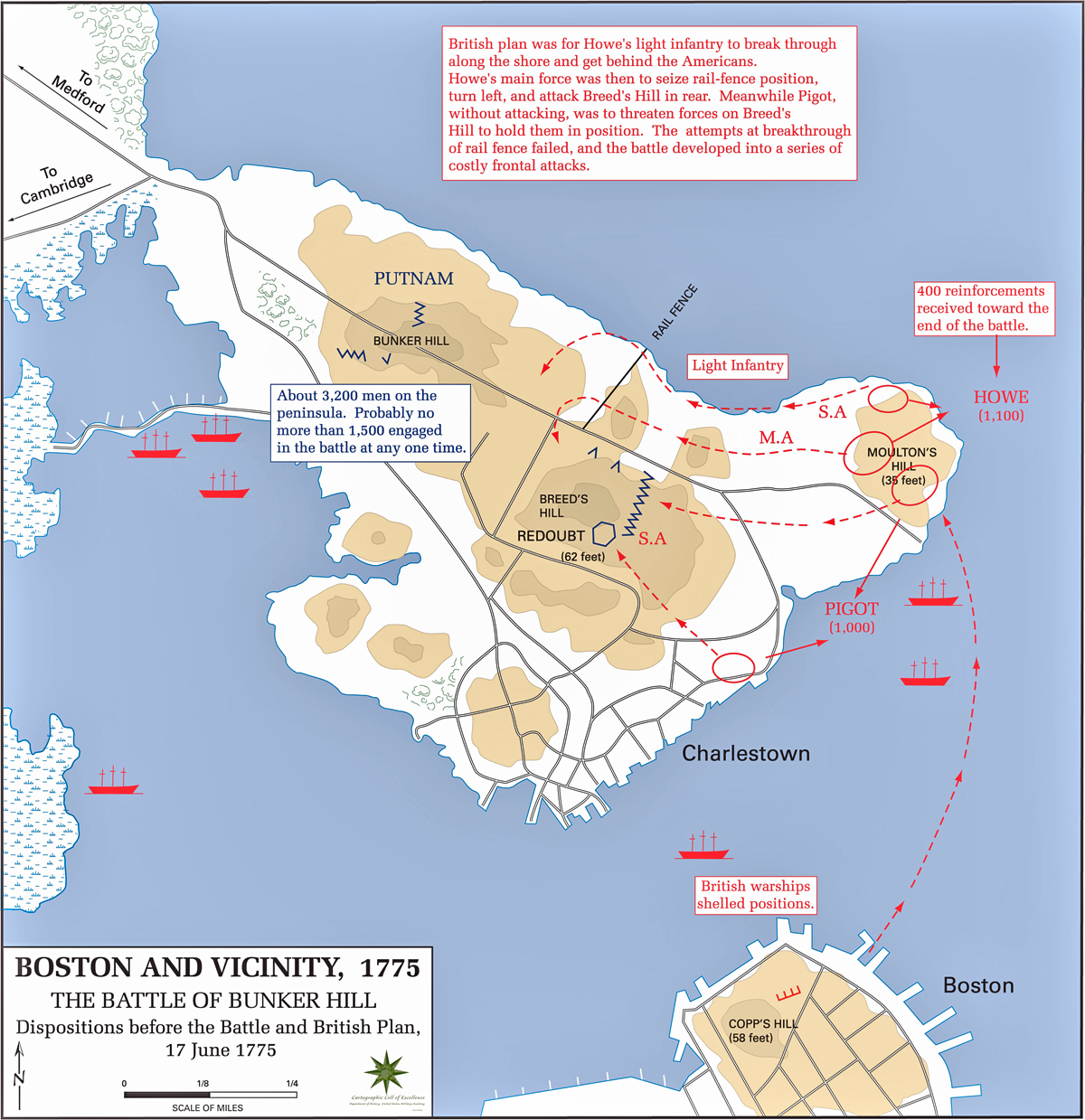
Posizioni americane sulla penisola di Charlestown - American positions on the peninsula of Charlestown

Movimenti delle forze britanniche - Movements of the British forces
Nei giorni successivi allo scontro di Lexington e Concord del 19 aprile 1775, una forza di 20.000 coloni americani si raduno nei dintorni di Boston.
Il generale Gage, preoccupato da questa massa di uomini, si rinchiuse nella città rinunciando a difendere le zone circostanti.
Il Congresso Provinciale del Massachusetts formò un esercito d’osservazione agli ordini del generale Jhon Thomas, lentamente andava prendendo forma l’assedio americano alla città.
Successivamente il Congesso Continentale, riunito a Filadelfia, costituì un Corpo d’osservazione.
Il 12 giugno Gage impose la legge marziale e decise l’occupazione di alcuni luoghi strategici nei dintorni di Boston, tra cui la penisola di Charlestown.
Scoperte le intenzioni britanniche la Commissione di sicurezza dei coloni americani, il 15 giugno decise di occupare la collina di Bunker Hill e di costruirvi delle opere di difesa.
Il 17 giugno 1775, quando sbarcarono sulla spiaggia della penisola di Cherlestown, i britannici dovettero affrontare circa 2.400 fanti americani con alcuni pezzi d’artiglieria, riparati dietro trincee e palizzate al comando del generale Israel Putnam, del colonnello Prescott e del dottor Warren.
Per lo svolgimento della battaglia e l’elenco delle forze britanniche rimando al post “Le unità britanniche alla battaglia di Bunker Hill / The British troops at the Battle of Bunker Hilldel 16 febbraio 2012.
La reale consistenza delle forze americane a difesa di Breed’s Hill non è certa, ma sembra che le truppe americane fossero le seguenti:

FORZE AMERICANE DEL CORPO DI OSSERVAZIONE
Comandante: maggior generale Israel Putnam (circa 2.400 fanti e alcuni pezzi d’artiglieria)

Brigata Prescott: colonnello William Prescott
            Rgt. Prescott (Massachusetts)
            Rgt. Freye (Massachusetts)
            Rgt. Bridge (Massachusetts)
            Rgt. Doolittle (Massachusetts)
Rgt. Brewer (Massachusetts)
Rgt. Nixon (Massachusetts)
Distaccamenti di schermagliatori a difesa della città di Charlestown
Batteria da 3 lb. di Gridley

Brigata Stark: colonnello John Stark
            Rgt. Stark (New Hampshire)
            Rgt. Reed (New Hampshire)
            Rgt. Knowlton (Connecticut) e Trevet (Mass.)

Le truppe americane erano totalmente formate da milizia, me non erano poi male, perché costituite anche da molti veterani delle guerre franco-indiane, inoltre molti miliziani erano abili cacciatori e quindi ottimi tiratori, soprattutto quelli armati di fucile rigato.
A discapito delle forze americane, invece c’era la mancanza quasi totale di baionette, che le rendeva vulnerabili nei combattimenti corpo a corpo e la mancanza di un comando unificato e di una linea di comando ben stabilita. Anche la mancanza di un valido rifornimento di munizioni ebbe un effetto negativo sull’esito finale del combattimento.
La brigata Stark - Stark Brigade

Gli abitanti di Boston seguono la battaglia dai tetti della città - The inhabitants of Boston follow the battle from the rooftops of the city

In the days after the battle of Lexington and Concord on April 19, 1775, a force of 20,000 American settlers are gathering in the Boston area.
General Gage, worried by this mass of men, shut himself up in the city refusing to defend the surrounding areas.
The Provincial Congress of Massachusetts formed an army of observation under General John Thomas, was slowly taking shape the American siege of the city.
Subsequently, the Continental Congesso meeting in Philadelphia, built a body of observation.
On June 12 Gage imposed martial law and decided the occupation of certain strategic locations in the Boston area, including the peninsula of Charlestown.
On 15 June, the Security Commission of the American colonists discovered the British intentions and decided to occupy the hill Bunker Hill building defense works.
On 17 June 1775, when they landed on the beach Cherlestown peninsula, the British were faced with about 2,400 American soldiers with a few pieces of artillery, trenches and take cover behind fences, under the command of General Israel Putnam, Colonel Prescott and Dr. Warren.
For the conduct of the battle and the list of British forces refer to the post "Le truppe britanniche alla battaglia di Bunker Hill / The British troops at the Battle of Bunker Hill" on 16 February 2012.
The real substance of American forces in defense of Breed's Hill is not certain, but it seems that American troops were the following:

AMERICAN FORCES OF THE CORPS OF OBSERVATION
Commander: Major General Israel Putnam (about 2,400 infantry and some artillery pieces)

Prescott Brigade: Colonel William Prescott
Rgt. Prescott (Massachusetts)
Rgt. Freye (Massachusetts)
Rgt. Bridge (Massachusetts)
Rgt. Doolittle (Massachusetts)
Rgt. Brewer (Massachusetts)
Rgt. Nixon (Massachusetts)
Detachments of skirmishers to protect the city of Charlestown
Battery 3-lb. Gridley

Stark Brigade: Colonel John Stark
Rgt. Stark (New Hampshire)
Rgt. Reed (New Hampshire)
Rgt. Knowlton (Connecticut) and Trevet (Mass.)

The American troops were fully formed by Militia, I was not too bad, because it made too many veterans of the French and Indian wars, many militiamen were also skilled hunters and good shooters, especially those armed with rifles lined.
To the detriment of U.S. forces, there was the almost total lack of bayonets, which made them vulnerable to melee combat and the lack of a unified command and a command line to be established. The lack of a good supply of ammunition had a negative effect on the final outcome of the fight.

Il generale Putnam - General Putnam

Il colonnello Prescott - Colonel Prescott

Il dottor Warren - Dr. Warren

sabato 7 aprile 2012

Documentazione sulla Guerra d’Indipendenza - Documentation on War of Independence


Oggi voglio parlarvi di due opere indispensabili a chi vuole avvicinarsi alla Guerra d’Indipendenza americana dal punto di vista storico, uniformologico e del wargame.
La prima è il libro “Uniforms of the American Revolution” di Jhon Mollo e Malcom McGregor.
Si tratta di un libro pubblicato negli anni settanta che ha avuto numerose riedizioni.
Le numerose illustrazioni di McGregor e il testo di Mollo presentano le uniformi dei combattenti, l’organizzazione degli eserciti, alcuni ordini di battaglia e una sintetica, ma completa descrizione delle campagne.
Alcune notizie sulle uniformi sono un po’ datate se confrontate alle nuove ricerche di studiosi attuali come Don Troiani, ma nonostante questo è un ottimo libro che da una panoramica completa del conflitto.
Oggi non è facile trovarlo, ma è ancora possibile, attraverso E-Bay o Amazon.com ad esempio.
In Italia potete provare presso Tuttostoria o Libreria Militare.
La seconda opera è un libro digitale (un CD-Rom con files .PDF).
Si tratta di “Uniforms of the American Revolution 1775-1783 – Combined Volumes 1 & 2” di Timothy J. Reese.
Presenta tutte le uniformi dei reggimenti britannici, francesi e tedeschi e buona parte di quelle indossate dagli americani, raccoglie anche molte bandiere. Il testo descrive la storia dei reggimenti coinvolti e alcune annotazioni sulle uniformi.
Anche quest’opera non può mancare agli interessati del periodo, è più facilmente reperibile anche se un po’ cara, ma ne vale la pena.
In Italia il CD può essere acquistato per corrispondenza presso Tuttostoria di Parma, all’estero può essere ordinato presso British Battles.

Buona Pasqua!


Today I want to talk about two essential works for those who want to get closer to the American War of Independence from the historical point of view, uniforms and wargames.
The first is the book "Uniforms of the American Revolution" by John Mollo and Malcolm McGregor.
This is a book published in the seventies who has had numerous reissues.
The numerous illustrations in the text of McGregor and Mollo have the uniforms of the combatants, the organization of armies, orders of battle and a concise but complete description of the campaigns.
Some news on the uniforms are a bit 'dated when compared to new research by scholars today as Don Troiani, but despite this is a great book by a complete overview of the conflict.
Today it is not easy to find, but it is still possible through E-Bay or Amazon.com for example.
In Italy you can try at Tuttostoria or
Libreria Militare.
The second work is a digital book (CD-ROM with PDF files).
It's "Uniforms of the American Revolution 1775-1783 - Combined Volumes 1 & 2" by Timothy J. Reese.
It has all the uniforms of the regiments British, French and German and most of those worn by the Americans, also collects a lot of flags. The text describes the history of the regiments involved, and some notes on their uniforms.
Even this can not fail to interested parties of the period, is more easily available even if a bit 'expensive but worth it.
In Italy the CD can be purchased by mail order from Tuttostoria of Parma, abroad can be ordered from British Battles.

Happy Easter!


Libro di Mollo e McGregor - Mollo & Mc Gregor's Book

Testo - Text


Americani e assiani - Americans and Hessians

Americani, realisti e indiani - Americans, Royalists and Indians
CD-rom di T. J. Reese - T. J. Reese's CD-rom 

Illustrazione di T. J. Reese - T. J. Reese's Picture

Illustrazione di T. J. Reese - T. J. Reese's Picture

Illustrazione di T. J. Reese - T. J. Reese's Picture

Illustrazione di T. J. Reese - T. J. Reese's Picture