wargameitaliablog

wargameitaliablog
Blog italiani di gioco, pittura, storia... wargames

Visualizzazioni totali

Lettori fissi

lunedì 4 agosto 2014

Maps of the Battle of Quatre-Bras

I want to undergo a series of interesting maps that show the Battle of Quatre-Bras in its various stages.
The images are taken from the book in French language:
Series "Les Batailles oubliees";
Historicone Editions.
It is an excellent text, which I recommend to all fans of the period and the campaign of Waterloo.

Voglio sottoporvi una serie di interessanti mappe, che mostrano la battaglia di Quatre-Bras nelle sue varie fasi.
Le immagini sono tratte dal libro in lingua francese: 
Serie “Les Batailles Oubliées”; 
Historicone Editions.
È un ottimo testo, che consiglio a tutti gli appassionati del periodo e della campagna di Waterloo.

Position of troops on the night between 15 and 16 June.
Posizioni delle truppe nella notte tra il 15 e il 16 giugno.

Quatre-Bras at 2 pm: advance of Marshal Ney.
Quatre-Bras alle 14.00: avanzata del maresciallo Ney.

Quatre-Bras between 3 and 4 pm: First attack of the French infantry.
Quatre-Bras tra le 15.00 e le 16.00: primo attacco della fanteria francese.

Quatre-Bras at half past 5 pm: Attack of the French Cuirassiers.
Quatre-Bras alle 17.30: attacco dei corazzieri francesi.


Ligny and Quatre-Bras: The useless marches and countermarches of I Corps of Marshal D'Erlon.
Quatre-Bras e Ligny: Le inutili marce e contromarce del I Corpo del Maresciallo D’Erlon.

Quatre-Bras: the charges of the French cavalry against the British squares; the temporary occupation of the crossroads by Kellermann.
Quatre-Bras: le cariche della cavalleria francese contro i quadrati britannici; la temporanea occupazione dell’incrocio da parte di Kellermann.

mercoledì 30 luglio 2014

7th Belgian Line Battalion, 1815

7th Belgian Line Infantry Battalion.
The infantry of Netherlands Army consisted of Dutch, Belgian, Nassau and Swiss mercenary troops.
An infantry battalion consisted of six Fusilier companies and two  companies of “Flanquers” (one equivalent to Grenadiers, the other to Light Infantry).
The Belgian infantry wore a uniform similar to that of the Dutch (blue coat with white facings), but with the distinctive “Belgic” shako in the British style.
The 7th Belgian Line Infantry Battalion, was in the Brigade of General van Bijlandt and was part of the 2nd (Netherlands) Division of Lieutenant General Baron de Perponcher-Sedlnitzky.
British historians of the Waterloo Campaign, often, have been ungenerous with the Dutch-Belgian Army.
The Belgian soldiers were unenthusiastic to fight against Napoleon, but did their duty.
The 7th Belgian arrived late at Quatre Bras, but it fought with courage and determination in the battle of Waterloo against the French I Corps.
On the behavior of the 7th Belgian at Waterloo, I suggest you read the book "The Battle" by Alessandro Barbero.
My 7th Belgian Line Battalion is made up of 16 figures (8 Fusiliers, 4 Grenadiers, 4 Light Infantry).
Figures of Front Rank.
Flags of Napflags.
Painted by Luca Onesti (Strategia Nova).

La fanteria dell'esercito dei Paesi Bassi consisteva di truppe olandesi, belghe, di Nassau e da truppe mercenarie svizzere.
Un battaglione di fanteria era composto da sei compagnie di fucilieri e due compagnie di "Flanquers" (una paragonabile ai granatieri, l'altra alla fanteria leggera).
La fanteria belga indossava un'uniforme simile a quella degli olandesi (giubba blu con risvolti bianchi), ma con il caratteristico shako "Belga" in stile britannico.
Il 7° Battaglione di Fanteria di Linea belga, era nella brigata del generale van Bijlandt e faceva parte della 2a Divisione (Paesi Bassi), del tenente generale barone de Perponcher-Sedlnitzky.
Gli Storici britannici della Campagna di Waterloo, spesso, sono stati ingenerosi con l'esercito belga-olandese.
I soldati belgi erano poco entusiasti di combattere contro Napoleone, ma hanno fatto il loro dovere.
Il 7° belga arrivò in ritardo a Quatre Bras, ma ha combattuto con coraggio e determinazione nella battaglia di Waterloo contro il I Corpo francese.
Sul comportamento del 7° belga a Waterloo, consiglio di leggere il libro "La Battaglia" di Alessandro Barbero.
Il mio 7° Battaglione di Linea belga è composto di 16 figure (8 fucilieri, 4 granatieri, 4 fanti leggeri).
Miniature della Front Rank.
Bandiere di Napflags.
Dipinti da Luca Onesti (Strategia Nova).

7th Belgian Line Infantry Battalion.

Command party.

Flank company (Grenadiers).

Flank company (Light Infantry).

Command party with Flag.

Badge of the shako.

Coat.

Fusilier.

Officer, drummer, grenadier and fusilier.

Grenadier N.C.O. and Officer of Fusiliers.

Original coat of a "Flanquer" N.C.O.

sabato 26 luglio 2014

1st Foot Guards Regiment, 1815

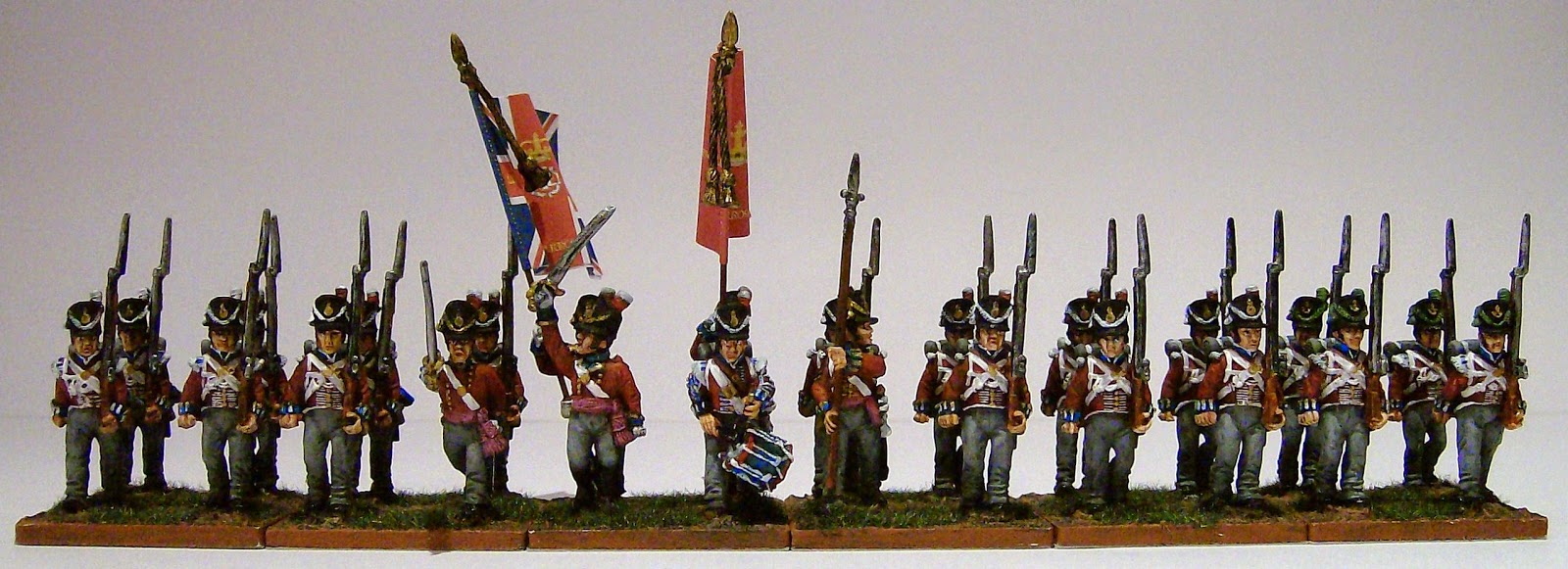
1st Foot Guards Regiment, 1815.
The 2nd and 3rd battalion of the 1st Guards Regiment belonged to the Major General Maitland Brigade of  Major General Cooke’s 1st British (Guards) Division.
The Foot Guards were uniformed like the line infantry, but with regimental distinctions.
Facings of all tree regiments of guards were dark blue, with gold lace for officers. Sergeants also wore gold lace, while that of the rank and file was white, in regimental patterns; the 1st Guards lace was equally spaced, in “bastion” shape.
The regiment carrying two regimental flags for each company.
My unit carries the insignia of the Second Company of the 1st Battalion.
My 1st Foot Guards contain 24 figures, including figures of the flank companies.
Figures of Front Rank.
Flags of Napflags.
Painted by Luca Onesti (Strategia Nova).

Il 2° e 3° battaglione del 1° Reggimento delle Guardie, appartenevano alla Brigata del maggior generale Maitland della 1a Divisione (Guardie) Britannica del maggior generale Cooke.
Le Guardie a Piedi erano vestite come la fanteria di linea, ma con le proprie distinzioni reggimentali.
Le mostreggiature di tutti e tre i reggimenti delle guardie erano blu scuro, con alamari dorati per gli ufficiali. Anche i sergenti indossavano alamari dorati, mentre quelli della truppa erano bianchi, nei modelli reggimentali; gli alamari del 1° Guardie erano distribuiti uniformemente, a forma di “bastione”.
Il reggimento portava due bandiere reggimentali per ogni compagnia.
La mia unità porta le insegne della seconda compagnia del 1° Battaglione.
Il mio 1° Guardie a Piedi contiene 24 figure, comprese le figure delle compagnie d’elite.
Miniature della Front Rank.
Bandiere di Napflags.
Dipinti da Luca Onesti (Strategia Nova).

1st Foot Guards Regiment, 1815.

Grenadier company.

Light infantry company.

Command party.

Command party.

Backpacks and equipment.

Officer coat.

Private coat.
Private, centre company.

Private, flank company.
N.C.O.
Drummer, officer, N.C.O., privates.

mercoledì 23 luglio 2014

British-Allied Order of Battle at Quatre-Bras


British-Allied Order of Battle at Quatre-Bras June 16, l8l5 (G. Naftziger)

Ordine di battaglia anglo-alleato a Quatre-Bras, 16 giugno 1815 (G. Naftziger)

Duke of Wellington

C. IN C. DUKE OF WELLINGTON

Prince of Orange
1ST CORPS: PRINCE OF ORANGE

Cooke
lst (British) Division: Major General Cooke

Maitland
lst (British) Brigade: Major General Maitland
2/lst Guards Regiment (l,02l)
3/lst Guards Regiment (l,066)

Byng
2nd (British) Brigade: Major General Sir Byng
2/Coldstream Guard Regiment (l,044)
2/3rd Guard Regiment (l,l04)

Artillery:
Sandham's Battery, RA, (5-9pdrs & l How)
Kuhlman's Battery KGL (5-6pdrs & l How)

Alten
3rd (Anglo-Hanoverian) Division: Major General Sir Charles Alten

C. Halkett
5th (British) Brigade: Major General Sir Colin Halkett
2/30th (Cambridgshire) Regiment (657)
2/73rd (Highland) Regiment (604)

lst (Hanoverian) Brigade: Major General Count von Kielmansegge
Bremen Field Battalion (552)
Verden Field Battalion (573)
York Field Battalion (647)
Lüneberg Field Battalion (635)
Grubenhagen Jager Battalion (66l)
Feldjäger Korps (340)

Artillery:
Lloyd's Battery, RA (5-9pdrs & l How)
Cleeve's Battery, RA (5-9pdrs & l How)

de Perponcher-Sedlnitzky
2nd (Netherlands) Division: General Lieutenant de Perponcher-Sedlnitzky

van Bijlandt
lst Brigade: General Major Bijlandt
7th (Belgian) Line (70l)
27th (Dutch) Line Battalion (809)
5th Militia Battalion (482)
7th Militia Battalion (675)
8th Militia Battalion (566)

Prince of Saxe-Weimar
2nd Brigade: General Major HSH Prince Bernard of  Saxe-Weimar
l/2nd Nassau Regiment (903)
2/2nd Nassau Regiment (903)
3/2nd Nassau Regiment (903)
l/Orange-Nassau Regiment (795)
2/Orange-Nassau Regiment (796)
Nassau Freiwilliger Jäger Det. (l co) (l69)

Artillery:
Stievenart Battery (8 6pdr guns)
Sijleveldt Battery (8 6pdr guns)

van Melen
3rd (Netherlands) Cavalry Brigade: Major General van Merlen
6th Dutch-Belgian Hussar Regiment (64l)
5th Belgian Light Dragoon Regiment (44l)


RESERVE CORPS: (UNDER WELLINGTON)

Sir Thomas Picton
5th (Anglo-Hanoverian) Division: Lieutenant General Picton

Kempt
8th Brigade: Major General Kempt
l/28th Foot Regiment (594)
l/32nd Foot Regiment (7l2)

Pack
9th Brigade: Major General Pack
3/lst Foot Regiment (648)
l/42nd Foot Regiment (56l)
2/44th Foot Regiment (485)
1/92nd Foot Regiment (?)

4th (Hanoverian) Brigade: Colonel Best
Verden Landwehr Battalion (66l)
Luneburg Landwehr Battalion (664)
Osterode Landwehr Battalion (7l7)
Munden Landwehr Battalion (700)

Artillery:
Rogers Battery (5-9pdrs & l How)
vonRettberg (5-9pdrs & l How)

Duke of Brunswick
Brunswick Contingent: HSH Frederick, Prince of Brunswick-Wolfenbuttel-Oels

Advanced Guard: Major von Rauschenplatt
Uhlan Sqn (232)
Hussar Regiment (690)

lst Brigade: Oberstlieutenant von Buttlar
Leib Battalion (672)
Advance-Guard Battalion (672)
lst Light Infantry Battalion (672)
2nd Light Infantry Battalion (672)
3rd Light Infantry Battalion (672)

2nd Brigade: Oberstlieutenant von Specht
lst Line Infantry Battalion (672)
2nd Line Infantry Battalion (672)
3rd Line Infantry Battalion (672)

Artillery:
Von Heinemann's Horse Battery (8 6pdr guns)
Moll's Foot Battery (8 6pdr guns)