wargameitaliablog

wargameitaliablog
Blog italiani di gioco, pittura, storia... wargames

Visualizzazioni totali

Lettori fissi

Visualizzazione post con etichetta Esercito Continentale - Continental Army. Mostra tutti i post

martedì 21 ottobre 2014

Sherburne's Additional Continental Regt. 1777

Col. Hanry Sherburne's Additional Continental Regiment, 1777.

Continental Line, on the right the Sherburne's Additional Continental Regiment.
The Col. Hanry Sherburne’s Additional Continental Regiment was raised in January 1777 by Henry Sherburne from Connecticut and Maryland recruits.
The regiment served in Connecticut 1777, throughout the Hudson Highland's, and in Rhode Island and New Jersey to 1780.
Sherburne’s unit served simultaneously in the same theaters and actions as Webb’s Additional Continental Regiment and in May 1780 was broken up, many of its soldiers grafted to Webb’s command. Abundant deserter descriptions all describe brown coats faced yellow and blue or green breeches.
My Sherburne’s Regiment is made up of 16 figures.
The soldiers are conversions of British redcoats from the Front Rank AWI range.
Flags by Quindia Studios.
Painted by Luca Onesti (Strategia Nova).

Il Reggimento Continentale Addizionale del colonnello Sherburne è stato creato nel gennaio 1777 da Henry Sherburne con reclute del Connecticut e del Maryland.
Il reggimento ha servito in Connecticut nel 1777, in tutte le Hudson Highland e in Rhode Island e nel New Jersey fino al 1780.
L’unità di Sherburne ha servito contemporaneamente e negli stessi teatri d’azione del Reggimento Continentale Addizionale di Webb e nel maggio 1780 è stata sciolta, molti dei suoi soldati sono confluiti nel comando del colonnello Webb. Numerose testimonianze da parte di soldati disertori descrivono giubbe marroni con mostreggiature gialle e calzoni blu o verdi.
Il mio Reggimento di Sherburne è costituito da 16 figure.
I soldatini sono conversioni di giubbe rosse britanniche dal range AWI della Front Rank.
Bandiere della Quindia Studios.
Dipinto da Luca Onesti (Strategia Nova).
  
Sherburne's Additional Continental Regiment in line.

View of the rear of the regiment.

Command party.

Command party.

Sherburne's Additional Continental Regiment advancing in line formation.

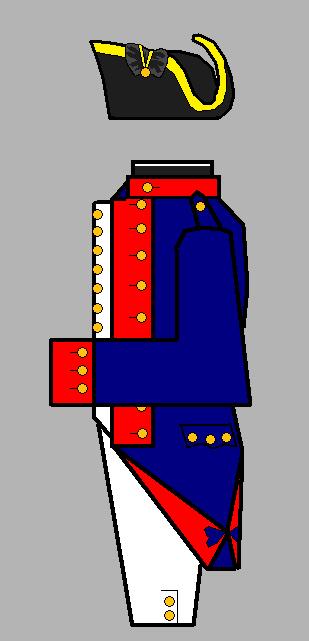
The regiment's uniform in my own illustration.

Officer (by Malcom Mc Gregor)

Private (by Charles Lefferts).

Private (by André Jouineau).

Private (by Don Troiani).

domenica 13 luglio 2014

14th Massachusetts Continental Regt. 1777

14th Massachusetts.

14th Massachusetts.
The 14th Massachusetts Continental Regt. fought at Saratoga, in defense of Philadelphia, and at Monmouth Court House. It was organized in spring 1777 at Boston to consist of 8 companies from Plymouth, Bristol, Barnstable, Suffolk, Cumberland and Worcester Counties. It was disbanded January 1, 1781 at West Point, New York.
The "Independent Chronicle" of October 22, 1778 reported a deserter clad in a “dark brown regimental coat, faced with light blue, reddish-brown waistcoat, peach blossom trousers”. In this instance trousers might mean gaiter-trousers or the straight-leg or “stovepipe” variety. Both are known to have been worn among many units.
My 14th Massachusetts is made up of 16 figures.
Front Rank figures painting by Luca Onesti (Strategianova).

Il 14° Reggimento Continentale del Massachusetts ha combattuto a Saratoga, in difesa di Philadelphia, e a Monmouth Court House. È stato organizzato nella primavera del 1777 a Boston con la consistenza di 8 compagnie provenienti dalle contee di Plymouth, Bristol, Barnstable, Suffolk, Cumberland e Worcester. Il reggimento è stato sciolto il 1 gennaio 1781 a West Point, New York.
L’Independent Chronicle del 22 ottobre 1778 ha riferito di un disertore vestito con “una giubba reggimentale marrone scuro, con mostreggiature azzurre, panciotto marrone rossiccio, pantaloni color fiori di pesca". In questo caso i pantaloni potrebbero essere stati delle ghette-pantalone o calzoni lunghi del tipo a "tubo di stufa". Entrambi sono noti per essere stati indossati da molte unità.
Il mio 14° Massachusetts è composto da 16 figure.
Soldatini Front Rank dipinti da Luca Onesti (Strategianova).

14th Massachusetts.

14th Massachusetts - rear view.

Command party (drummer and NCO)

Command party (standard bearer, officer and drummer).

Ligth company of 14th Massachusetts.

Ligth company of 14th Massachusetts.

Private in hunting shirt and officer.

The 14th Massachusetts in line.


Privates, officer an rear view.

NCO (red epaulet on the right-shape)

venerdì 4 luglio 2014

3rd New Jersey Continental Regiment, 1776

3rd New Jersey Continental Regiment, 1776.
During the July 4th holiday, I want to show my latest American regiment of my AWI project: the 3rd New Jersey Continental Regiment. 
The 3rd New Jersey Continental Regiment was organized February to May of 1776 at Elizabethtown to consist of 8 companies. It fought at Lake Champlain and in northern New Jersey, around New York in 1777, at Monmouth Court House, and against the Iroquois in 1779, then in 1780 returned to duty in its home state. It was primarily responsible for the rebuilding of Fort Stanwix and was posted to Fort Ticonderoga for a prolonged period of garrison duty. The 3rd was disbanded January 1, 1781 at Pompton, its men merged into the 1st and 2nd New Jersey regiments.
For the regiment, a uniform consisting of coats and belted waistcoats of light drab (almost a tan shade) and buckskin breeches was decided upon as it was organized.
The short coat had blue facings and pewter buttons.
The flag is based on that shown in the website of the group of re-enactors of the 3rd NJ Regiment.
The unit consists of 16 figures including 4 light infantry.
Figures Front Rank; officer by Wargames Foundry.
Painting by Luca Onesti (Strategianova).

In occasione della festa del 4 luglio, voglio mostrare il mio ultimo reggimento americano del mio progetto sulla Guerra d’Indipendenza Americana: il 3° New Jersey Continental Regiment. 
Il 3° New Jersey Continental Regiment fu organizzato nel Febbraio-Maggio del 1776 a Elizabethtown e consisteva di 8 compagnie. Ha combattuto sul Lago Champlain e nel nord del New Jersey, vicino a New York nel 1777, a Monmouth Court House, e contro gli Irochesi nel 1779, poi nel 1780 ritornò a prestare servizio nel suo paese d'origine. Fu il principale responsabile della ricostruzione di Fort Stanwix ed venne inviato a Fort Ticonderoga per un periodo prolungato di servizio di guarnigione. Il 3° fu sciolto il primo gennaio 1781 a Pompton, i suoi uomini furono integrati nel 1° e 2° reggimento del New Jersey.
Per il reggimento fu decisa, al momento della sua organizzazione, una divisa composta da giubba e panciotto di tessuto grigiastro chiaro (quasi una tonalità di marrone chiaro) e calzoni in pelle di daino.
La corta giubba aveva risvolti blu e bottoni di stagno.
La bandiera è basata su quella indicata nel sito web del gruppo di rievocatori storici del 3° NJ Regiment.
L'unità è composta di 16 figure di cui 4 di fanteria leggera.
Figure della Front Rank; ufficiale della Wargames Foundry.
Dipinto di Luca Onesti (Strategianova).

3rd New Jersey Continental Regiment, 1776.

3rd New Jersey Continental Regiment, 1776.
Command Party.

Captain, standard bearer and drummers.

Centre company.

Light company.

Light company.

Backpacks and equipment. Note the inscription "3rd NJ."
3rd NJ. Flag.
3rd NJ. Flag.
1) Private. 2) Officer.

Privates, officer and drummer.

"3rd NJ (Jersey Blue)" of Don Troiani.


sabato 26 maggio 2012

CORRECTION! American uniforms of 1775 -1776 – ERRATA CORRIGE! Uniformi americane del 1775 -1776


Al contrario di quello che credevo di aver fatto, mi sono reso conto di non aver riportato correttamente tutti i nomi dei reggimenti illustrati nelle mie tavole del post sull’esercito americano del 1775/76.
Ho provveduto a correggere e aggiornare il post in questione.
Mi dispiace per l’errore.

Contrary to what I believed to have done, I realized I have never been properly explained all the names of the regiments in my tables of the American army post 1775/76.
I have taken action to correct and update the post in question.
Sorry for the mistake.


mercoledì 23 maggio 2012

Le truppe americane nel 1775 - American troops in 1775


ORGANIZZAZIONE
Le colonie avevano sempre avuto una milizia provinciale organizzata sul modello dei reggimenti britannici.
Queste truppe erano diventate abbastanza agguerrite durante la guerra franco-indiana, ma in seguito avevano perso di efficacia.
Con l’aumentare delle tensioni tra la corona britannica e i coloni americani, le forze della milizia del New England furono aumentate.
I veterani e i tiratori più esperti furono riuniti in compagnie d’elite che potevano mobilitarsi in brevissimo tempo, questi uomini furono chiamati Minute-men.
Gli uomini più anziani o meno capaci furono riuniti in compagnie d’allarme.
Di solito i reggimenti della milizia erano suddivisi in 10 compagnie.
Con lo scoppio delle ostilità, il Comitato di Sicurezza propose di formare un Esercito di Osservazione di 30.000 uomini del New England, tra cui 13.000 del Massachusetts.
Il Massachusetts formò 23 reggimenti di fanteria e 1 di artiglieria, di 10 compagnie ciascuno.
Il New Hampshire creò 3 reggimenti di 10 compagnie ciascuno per un totale di 1.900 uomini (con molti veterani). Il Rhode Island inviò 3 reggimenti di 7 o 8 compagnie.
In totale 1.500 uomini e una compagnia d’artiglieria.
Il Connecticut organizzò 6 reggimenti di 6.000 uomini.
L’esercito, aveva uomini validi, ma mancava di armi, munizioni, uniformi e di un comando centralizzato, ma si comportò bene a Bunker Hill.
Il 14 giugno 1775 il Congresso Provinciale decretò la formazione di un esercito nazionale, detto Esercito Continentale, arruolando 10.000 (poi 22.000) uomini per l’assedio di Boston e in seguito ne diede il comando al generale Washington.
Washington stabilì che ogni reggimento Continentale avrebbe avuto 8 compagnie di fanteria con 4 ufficiali, 4 sergenti, 4 caporali, due tamburini e 76 soldati semplici per ogni compagnia.

UNIFORMI
All’inizio non esistevano uniformi, in seguito i reggimenti si dotarono in parte di uniformi con colori reggimentali.
I soldati potevano indossare tre tipi di tenuta: l’abito civile, l’uniforme di taglio britannico oppure la cosiddetta “camicia da caccia”, più economica e di facile produzione.
L’uniforme di tipo europeo era di solito in tessuto marrone o più raramente blu, con risvolti, polsini, colletto e falde nei colori del reggimento (spesso rossi, bianchi o gialli).
Esistevano anche uniformi grigie o coloro camoscio e colore distintivo verde, azzurro, ecc.
Il copricapo poteva essere un tricorno oppure un cappello a falde larghe.
Le insegne di grado erano le seguenti:
comandante in capo – nastro azzurro a tracolla;
maggior generale – nastro porpora;
brigadiere generale – nastro rosa;
aiutante di campo – nastro verde;
ufficiale superiore – coccarda rossa o rosa sul tricorno;
capitano – coccarda gialla o color bufalo;
ufficiale subalterno – coccarda verde;
sergente – spallina destra rossa;
caporale – spallina destra verde.


ARMI
Molti miliziani erano armati di fucili da caccia a canna rigata oppure con moschetti tipo “Brown Bess”. Quasi tutti non avevano la baionetta che li rendeva vulnerabili negli scontri a corpo a corpo.
Spesso però possedevano coltelli da caccia asce e altre armi da taglio.
Gli ufficiali erano armati di sciabola o spada e spesso di picca, qualche volta anche di moschetto.

Nota:
prego i lettori di scusarmi se dovessero trovare degli errori nel testo dovuti alla mia scarsa dimestichezza con l'inglese o alla mia disattenzione. Grazie.


ORGANIZATION
The colonies had always had a provincial militia organized along the lines of the British regiments.
These troops had become quite aggressive during the French and Indian War, but later lost effectiveness.
With rising tensions between the British Crown and the American colonists, the militia forces of New England were increased.
The veteran shooters and experts were brought together in the elite companies that could mobilize in a short time, these men were called Minute-men.
Older men were less able or meeting alarm companies.
Usually the militia regiments were divided into 10 companies.
With the outbreak of hostilities, the Security Committee proposed to form an Army of Observation of 30,000 men in New England, including 13,000 in Massachusetts.
The Massachusetts formed 23 regiments of infantry and 1 artillery, 10 companies each.
The New Hampshire regiments of 10 companies created 3 each for a total of 1,900 men (veterans).
The Rhode Island sent 3 regiments of 7 or 8 companies.
In total 1,500 men and a company of artillery.
The Connecticut regiments of 6,000 men organized 6.
The army men had valid, but lacked arms, ammunition, uniforms and a centralized control, but did well at Bunker Hill.
On June 14, 1775 the Provincial Congress decreed the formation of a national army, said Continental Army, enlisting 10,000 (later 22,000) men for the siege of Boston and later gave the command to General Washington.
Washington decided that each regiment would have had 8 Continental infantry companies with 4 officers, 4 sergeants, 4 corporals, two drummers and 76 privates per company.

UNIFORMS
At first there were no uniforms, following regiments are endowed in part with regimental colors of uniforms.
The soldiers could wear three rings: the civil suit, the uniform shear British or the so-called "hunting shirt", cheaper and easy to produce.
The uniform European-type fabric was usually brown or blue, more rarely, with lapels, cuffs, collar and flaps in the regimental colors (often red, white or yellow).
There were also those suede and gray uniforms or distinctive color green, blue, etc..
This could be a tricorn hat or a broad-brimmed hat.
The insignia of grade were as follows:
Commander in Chief - blue ribbon over the shoulder;
Major General - purple ribbon;
Brigadier General - pink ribbon;
adjutant - green ribbon;
superior officer - pink or red ribbon on the three-cornered hat;
Captain - rosette or yellow-colored buffalo;
subaltern - green cockade;
Sergeant - red right shoulder;
Corporal - Green right shoulder.

WEAPONS
Many militiamen were armed with shotguns with rifled muskets, or type "Brown Bess". Almost all had the bayonet which made them vulnerable in melee fights.
Often, however, had hunting knives axes and other edged weapons.
The officers were armed with saber or sword and pike often, sometimes with a musket.

Note:
Please excuse me if readers were to find errors in the text due to my unfamiliarity with the English or to my carelessness. Thank you.